 Liberty Rose Ayon was one of my Advanced Composition students a month ago. Besides the article posted below, you can read other entries in her blog.
my poignant reality (December 24, 2007, 6:15 AM)
i think the Christmas Spirit has gone somewhere but visit me
i can't help but feel nothing
a few months before the calendar showed December, i felt a little apprehensive for i kind of expect what this month will be for me...i am once again feeling and living the real-what-my-life-is...believe it or not, but behind this smiling eyes are tears roaming just around the corner...
i am really sad...
sad that i won't be spending this Christmas Eve with my mom and dad...
sad knowing that my big brother will be spending his Christmas Eve alone too...
sad that i am not even brave enough to let my tears show...
sad that i dare not even talk about and with the 'elephant in the room'
sad that i have to end and remember this year marked with a broken friendship
sad that separation is a reality way too painful
sad that i am sad
yet, i know that Christmas is not about emotions and capturing all the shiny glittering lights engulf you into feeling that wonderful Christmas Spirit...Christmas is more than that...it is remembering how God showed His love by giving Jesus to us...Jesus, Who came as a Babe to become the Man that will die on the cross for our sins...
God must have been sad too to let His Son leave Him and come to this world...
i have to feel this now though...ignoring this feeling would just lengthen this state...
but like everything else in this world, this will end too...
this will end
...
Friday, February 26, 2010
Liberty’s thoughts


Thursday, December 10, 2009
Remember a missionary this Christmas
Missionary Christmas
Christmas was special when he was a child,
food and presents and carols and smiles.
Tree decorating was great family fun,
and cold nights by the fire watching old reruns.
But then one day God spoke to his heart,
and he gave up his culture to make a new start.
Now taking the Gospel to far off lands,
his Christmas is different than what he had planned.
The weather is sticky, with stench in the air,
the needs that surround him are terrible to bear.
Instead of carols and Christmas bells,
he hears chanting and the casting of spells.
The childhood dream of Christmas in the snow,
was left at the altar when he decided to go.
If only the ones who he left behind,
would remember his face during this special time.
And send him a note, or a word of thanks
or maybe even something he could put in the bank.
Then Christmas would not be so tough this year
and even for the missionary it would “good cheer.”
©Wayne Dillard 2004
www.prayercentral.net
Thursday, September 3, 2009
Picture no. 19 (series): Learning to see
Way back in 1989, I enrolled in a fifteen Saturday black and white photography course in an art school. For the first assignment, the instructor asked the class to use one roll of film to shoot lines, shapes, form, textures, etc. On your own, therefore, using whatever camera you have, shoot as many pictures as you can of lines, shapes, forms, etc. This exercise will teach you how to break down an image into the different elements.
Later on you can combine these elements into a photograph that appeals to your own sense of beauty. Hopefully, other people will share your joy and sense of fulfillment over the pictures you have taken. My idea of beauty, if you care to know (please, please), is embodied in the Japanese ideal of “elegant simplicity.”
The human eye and the camera see things differently
Charles Darwin, father of evolution, once said, “When I think of the complexity of the human eye, I shudder.” With the interplay of rods and cones which enable it, among other things, to distinguish numerous shades of colors, the human eye is so enormously complex that evolution fails dismally in explaining it. (Incidentally, two books I highly recommend to you are “Fearfully and Wonderfully Made” and “In His Image” by Philip Yancey and Dr. Paul Brand. These books are about the wonders and complexities of the human body.
A basic principle you have to understand and always keep in mind is that the human eye and the camera see things differently. This is why, a lot of times, we get disappointed with the results of our pictures. Whenever we look at the subject we want to shoot, we always see a “focused” image, that is, a sharp image from foreground to background. This is because the eye, even without us consciously knowing or doing anything about it, adjusts itself to focus on whatever we are presently looking at, excluding other details in the scene. The camera cannot do this.
If you’re using a manual focus camera, you have to turn the focusing ring until you get the right focus, that is, the image appears sharp and clear as you look at it through the viewfinder. With autofocusing systems, you just depress the shutter release a little bit and the camera automatically adjusts itself to focus on your subject. The difference in what the eye and what the camera see oftentimes result in a photograph that contains a lot of clutter or distracting details, which we didn’t notice while looking at the subject through the viewfinder. Take a look at the picture to the left (a choral competition) for example. When I was looking at the scene with the camera, I didn’t notice all the students at the background because they looked fuzzy or out of focus in the viewfinder. The camera however recorded everything - the performing students, and all the distracting details in the background.
 Notice for example the picture of my cute nephew JR. (He’s cute because he looks like me!) Please notice that while JR himself is sharp and clear, the background details are deliberately blurred and out of focus.
Professional photographers oftentimes derisively use the term “record shot.” Hey! “Derisive” is such a big word; I’d better check my dictionary to check if I got the spelling right! The term “record shot” is used to describe certain pictures that simply have to be taken for record purposes (to be redundant about it), or because the person paying for the photographer’s services simply wanted to have certain subjects shot. Meaning, there is nothing artistic in the subject matter or in the technique used; the photographer simply pointed his or her cameras at the subject, and took the shot.
Photographs have the power to convey a mood or share your insights with others
If you are using your camera just to do record shots, you are definitely missing out on what photography is all about as an art form. Photographs have the power to convey a mood or share your insights with others. All you really have to do is to begin seeing things, not just looking at them. Remember what the fox said to the Little Prince? “What is essential is invisible to the eyes; one must look with the heart.”
Photographers can see beauty where other people can only see mundane, crass, everyday things. Photographers, like all truly creative artists, have learned, as Walt Whitman (the father of free verse, the poet of democracy) once wrote, “to see beauty in a single blade of grass.” Wow!
Ways of developing your creative eye
The question most of you must be asking desperately by now is, “How? How do I develop this visual awareness, this creative eye?” While some people are blessed with innate artistic talents, most of us can learn how to be creative with a camera. As Ernst Haas once said, “If art is aristocratic, then photography is its democratic voice.” The following are some of the techniques in developing your creative eye. Look at the picture to the left. Since you can’t turn your computer monitor upside down, stand up and then look at this picture with your head upside down. I know it’s a little bit acrobatic but hey it’s worth it! You will know what this picture is all about. The image of the trees, students and building are all repeated as reflections in the water in the foreground area. (This is probably the best picture I have ever taken in my life.)
I took this picture shown above way back in October 1989. I’ve noticed previously that every time it rained hard, the front area of the gymnasium of Rizal High School in Pasig would become flooded and there would be reflections on the water of the trees and that building on the background. I decided that this would make a good subject for a photograph. And so I brought my beloved Canon AE-1 Program everyday with me to school, and waited for the rain to come. I brought along my camera every day for one month, and it didn’t rain for one whole month! And so one day, I simply gave up and left my camera at home. Guess what happened? It rained hard that day!
I went home after the lunch break (pizza!), got my camera and loaded it with Negrapan (a black and white film manufactured in Spain). I knew I couldn’t use color film because the water was muddy brown in color; with monochrome film, it didn’t matter. I didn’t have a zoom lens at that time and so I used my Canon FD f/1.8 normal lens. I got back to school at around four in the afternoon. I focused on the reflections, and because it was late afternoon, I was forced to use a slow shutter speed of 1/30 sec. with an f/5.6 lens opening, for the right depth of field. (Later on we’ll discuss shutter speeds, lens openings and depth of field.) Pay attention to details! When you’re just starting to learn about photography, don’t consider anything too small, too trivial or too insignificant. The folk dancer in picture above has a V-shaped black ribbon on her costume; notice how the out of focus highlights on the background form an inverted letter V.
 Pay attention to details! When you’re just starting to learn about photography, don’t consider anything too small, too trivial or too insignificant! If you look hard enough, you will notice that cute ribbon tied to my student's shoe buckle ... you know how vain girls are! I was able to take only one shot before my student kicked me away!
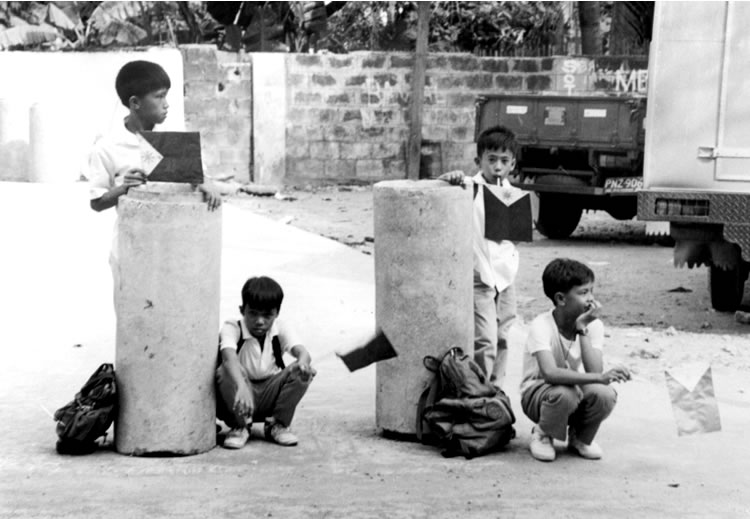 How many pipes are there in the picture above? Two. How many boys are standing up? Two. How many boys are sitting down? Two. How many boys are looking towards the right? Two. How many boys are looking towards the camera? Two.
Look at paintings; watch good music videos. Look at comic books on superheroes; they have brilliant colors, subtle shadings, clean and dynamic lines. By the way, which superhero works as a photojournalist? Peter Parker, a.k.a. Spiderman!
Read poetry, short stories and other creative fiction, and then visualize in your mind the ideas, emotions expressed in them. One time, after reading Tennyson’s poem “Flower in a Crannied Wall,” I took my camera and for nearly a week, shot a lot of walls. I couldn’t find a single flower in a crannied wall but I did find a lot of small plants, a lot of moss between cracks in the walls, and our neighbors had a jolly good time watching me inspecting and shooting close-ups of walls in our compound!
Practice visualizing things. In the novel “The Heart is a Lonely Hunter” written by Carson McCullers, Mickey, the main character, wanted desperately to learn how to play the violin. She drew a violin on a piece of cardboard, cut it out and then listened for weeks to the classical music being played by a neighbor. Wow, talk about visualization! What happened? Did Mickey become a world-class violinist? Of course not! What do you think this is, real life? Get real! This is fiction! Mickey became a waitress at the end of the novel. Look for symbolisms and relationships. I took this picture way back in 1986 during the original EDSA Revolution. What are the symbolisms here? The soldier is the defender of freedom and democracy (symbolized by the Philippine flag in the background) and the child he’s carrying is the beneficiary of that freedom and democracy.
Look for symbolism and relationships. I tried to say in the picture to the left that students (represented by the bags) were waiting for the building to be finished. I know, I know, it’s really corny!
Practice doing still life. These milk cans were rusting away near a santol tree. I’ve seen them several times before but I felt that they needed something else to perk up the image. I looked around, saw an old rubber doll my cute nephew (who looks like me) had outgrown, and placed it inside one of the milk cans.
What does this discussion have to do with learning English through creative writing? Well, you will find out that different people see different things even when viewing the same photograph. This makes writing through the use of pictures a very interesting class activity.You can also teach your students (if you are a teacher) or learn as a student how to think critically. Try this activity: Teach Them To See - Higher Level Thinking And Tasks Through Photojournalism
Monday, August 10, 2009
Through the distance ...
 “And Mizpah; for he said, The LORD watch between me and thee, when we are absent one from another.” (Gen 31:49)
“Is the Lord going to use in a great way? Quite probably. Is He going to prepare you as you expect? Probably not. And if you’re not careful, you will look at the trials, the tests, the sudden interruptions, the disappointments, the sadness, the lost jobs, the failed opportunities, the broken moments, and you will think, He’s through with me, He’s finished with me, when in fact, He is equipping you.” (The Mystery of God’s Will, by Chuck Swindoll)
Friday, February 13, 2009
Daily writing tips for students, teachers and others
 Whether you are a student, teacher, an attorney, manager, or blogger, writing skills are essential for your success. Considering the rise of the information age, they are even more important, as people are surrounded by e-mails, wikis, social networks and so on. It can be difficult to hone one’s writing skills within this fast paced environment. Daily Writing Tips is a blog where you will find simple yet effective tips to improve your writing.
Categories include Book Reviews, Business Writing, Competitions, Expressions, Fiction Writing, Freelance Writing, General, Grammar, Grammar 101, Misused Words, Punctuation, Spelling, Vocabulary, Word of the Day, and Writing Basics.
Most popular articles are: 40 Yiddish Words You Should Know; The Impotence of Proofreading; 6 Foreign Expressions You Should Know; Let the Word Do the Work; 10 Rules for Writing Numbers and Numerals; 50 Incorrect Pronunciations That You Should Avoid; 12 Greek Words You Should Know; 34 Writing Tips That Will Make You a Better Writer; Gross Writing Errors on the Web; Creative Writing 101; Latin Words and Expressions; Usage That Provokes “Blackboard Moments”; and 44 Resume Writing Tips. You can also measure your writing skills with DWT’s monthly updated tests. Current tests include Vocabulary Test 1, Spelling Test 1, Grammar Test 1, and Vocabulary Test 2.
You can get DWT via RSS Feed, or by email, and stay tuned for your writing tips!
Monday, January 5, 2009
Free photos for Christian publications
 ChristianPhotos.net is a leap of faith. Everything is free - you can download high resolution stock photography for Christian purposes without having to pay anything - expenses are covered by donations and ads. The photos can be used freely in Christian advertisements, program booklets, bulletins, invitations, newsletters, religious education materials, flyers, posters and any other project for which photos are needed. The vision of ChristianPhotos.net is simple: it wants to help churches to publish better material for spreading the word of Gospel. You can also submit your own photos.
Photo categories include Religious, People, Animals, Scenery, Plants, Macro, Artistic, Objects, and Uncategorized.
Apply now for a free account.
Sunday, December 21, 2008
Picture no. 18 (series): Clouds and nostalgia
 These two pictures show the athletic oval and the Main Building of Rizal High School, Pasig City, Metro Manila.
In the 1990’s the Guinness Book of World Records credited the school as the largest high school in the world, with its enrollment reaching a high of 26,000 students at one point in time.
I took the sepia-toned picture in 1995 and the colored picture in 1996. If you are a beginning photographer wondering how you can get great cloud shots, you can simply fit a filter (polarizing or graduated) on the lens of your single lens reflex camera.
Bows and flows of angel hair and ice cream castles in the airI don't know about you but for me, sepia-toned or black and white pictures can evoke nostalgia better than colored pictures. Posted below are some quotations about nostalgia:
And feather canyons everywhere, I’ve looked at clouds that way.
But now they only block the sun, they rain and snow on everyone.
So many things I would have done but clouds got in my way.
I’ve looked at clouds from both sides now,
From up and down, and still somehow
It’s cloud illusions I recall.
I really don’t know clouds at all.
Owens Lee Pomeroy: “Nostalgia is like a grammar lesson: you find the present tense, but the past perfect!”
Author Unknown: “People seem to get nostalgic about a lot of things they weren't so crazy about the first time around.”
Bill Vaughn: It’s never safe to be nostalgic about something until you're absolutely certain there's no chance of its coming back.
Florence King: “True nostalgia is an ephemeral composition of disjointed memories.”
Lou Reed: “I don't like nostalgia unless it's mine.”
Ted Koppel: “It becomes increasingly easy, as you get older, to drown in nostalgia.”
Doug Larson: “Nostalgia is a file that removes the rough edges from the good old days.”
Will Rogers: “Things ain't what they used to be and probably never was.”


